

The Lion Pride Museum Fall 2026
Preview
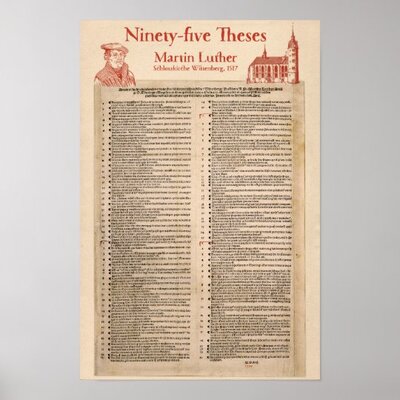
Publication Date
1517
Place (Bibliographic Info)
Wittenberg, Holy Roman Empire.
Description
The Ninety-Five Theses originally appeared as a single printed sheet, also known as a broadsheet. It was printed on paper with ink and contained 95 statements written in Latin. Its simple layout reflects how printed documents were used to communicate ideas and encourage public discussion.
Martin Luther wrote the Ninety-Five Theses in 1517 to challenge certain practices of the Catholic Church, especially the selling of indulgences. He believed these practices were not properly supported by scripture. Although the theses were originally intended for academic discussion, printing helped spread Luther's ideas throughout Europe.
This artifact is important because it shows how people began questioning religious authority and traditional practices. These changes affected ordinary people by encouraging discussions about church teachings, forgiveness, and personal faith. The spread of Luther's ideas also contributed to the Protestant Reformation, which changed Christianity and created new religious communities. I chose this artifact because it shows how questioning religious practices could lead to major changes in society and the way people understood their faith.
Keywords
Christianity