

The Lion Pride Museum Fall 2026
Preview
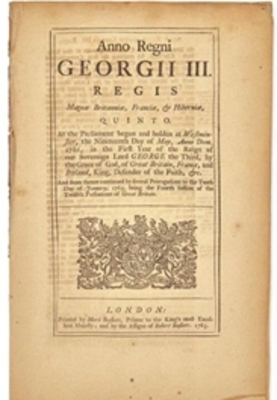
Publication Date
1765
Place (Bibliographic Info)
Great Britain. Parliament. Anno Regni Georgii III. Regis Magnae Britanniae, Franciae, & Hiberniae, quinto: At the Parliament begun and holden at Westminster... London: Printed by Mark Baskett, 1765. Library of Congress, Manuscript Division, John Davis Batchelder Collection. The Library of Congress
Description
The Stamp Act of 1765 became an important turning point in the relationship between Britain and the American colonies. The law required taxes on printed materials, including newspapers, pamphlets, legal documents, and other paper products. Unlike taxes on certain goods, the Stamp Act directly affected the way colonists communicated and conducted everyday business. Because printed materials were used by nearly every part of colonial society, the tax was seen as an intrusion into both economic and political life.
The tax was especially controversial because it affected the people responsible for producing and distributing information. Printers and publishers had to pay for stamps on many of the materials they produced, which increased costs and complicated their businesses. Political writers also faced the possibility that the cost of publishing their arguments would increase. This made the Stamp Act more than an economic issue. It became connected to questions about freedom of expression, political participation, and Britain's authority over colonial life.
The controversy also demonstrated the connection between print and political resistance. The same newspapers, pamphlets, and documents that Britain attempted to tax could also be used by colonists to criticize British policies. As resistance grew, printed materials became an important way for colonists to share information and organize opposition.
Keywords
The American Revolution, Stamp Act